


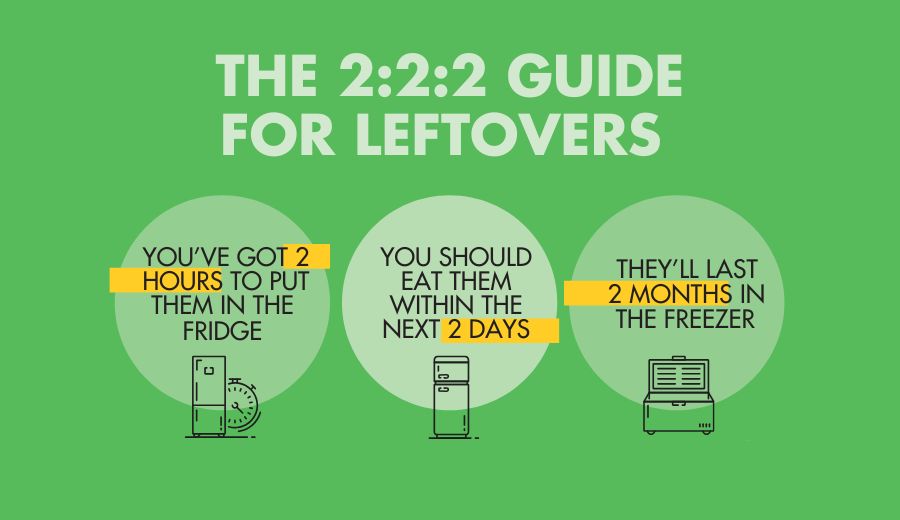
The 2-2-2 rule for food safety is a simple way to remember how to handle leftovers. In its common form, the rule means:
- 2 hours: Get leftovers into the refrigerator within 2 hours.
- 2 days: Eat refrigerated leftovers within about 2 days.
- 2 months: Use frozen leftovers within about 2 months for best quality.
The 2-2-2 rule is useful as a simple household reminder, but it is not a universal official USDA storage rule. USDA guidance provides different refrigerator and freezer storage times for different foods. For example, many cooked meat and poultry leftovers can be refrigerated for 3 to 4 days when properly stored at 40°F (4°C) or below.
What Does the 2-2-2 Rule Mean?
The rule is designed to make leftover food safety easy to remember.
The First 2: Refrigerate Within 2 Hours
Perishable foods should not sit at room temperature for more than 2 hours.
If the surrounding temperature is above 90°F (32°C), the safe time drops to 1 hour.
This includes foods such as:
- Cooked meat
- Chicken and turkey
- Fish and seafood
- Eggs
- Dairy products
- Cooked rice and pasta
- Casseroles
- Soups and stews
- Restaurant leftovers
- Foods containing meat or dairy
Bacteria multiply quickly in the temperature range known as the Danger Zone, approximately 40°F to 140°F (4°C to 60°C).
The Second 2: Eat Within 2 Days
The second part of the 2-2-2 rule suggests eating refrigerated leftovers within two days.
This is a simple conservative guideline for households, especially when you are unsure about how long a particular leftover can safely be stored.
However, official USDA guidance allows many properly refrigerated cooked leftovers to remain safe for 3 to 4 days.
So, if you’re following official USDA guidance, you don’t necessarily have to throw away every leftover after exactly two days.
The Third 2: Freeze for Up to 2 Months
The final part of the 2-2-2 rule recommends using frozen leftovers within two months.
Freezing food at 0°F (-18°C) or below keeps it safe for much longer, although quality can decline over time.
For example, USDA lists several cooked foods with recommended freezer storage periods ranging from approximately 1 to 6 months depending on the food.
Therefore, the “2 months” portion of the 2-2-2 rule is best viewed as a simple quality guideline, not a universal safety deadline.

Why Is the 2-Hour Rule So Important?
The two-hour rule is one of the most important parts of food safety.
When perishable food stays between 40°F and 140°F, bacteria can multiply rapidly. Leaving food at room temperature for more than two hours increases the risk of foodborne illness.
If the temperature is above 90°F, such as during a very hot day or a power outage in a hot home, the recommended limit is only one hour.
This is particularly important during:
- Summer heat
- Picnics
- Parties
- Buffets
- Power outages
- Camping
- Long-distance food transportation
Does the 2-2-2 Rule Apply During a Power Outage?
The 2-2-2 rule can help with general leftover management, but a power outage requires additional considerations.
A refrigerator without electricity generally keeps food cold for about 4 hours if the door remains closed.
During an outage, the most important question is whether the food remains at 40°F or below, rather than simply counting how long the electricity has been off.
If perishable food has been above 40°F for approximately four hours or more, it may need to be discarded.
For longer outages, transfer perishable foods to a cooler with ice or frozen gel packs and keep them at 40°F or below.
How Should You Store Leftovers?
Proper storage is just as important as storage time.
Use Shallow Containers
Large amounts of hot food should be divided into smaller, shallow containers. This allows food to cool more quickly in the refrigerator.
Cover the Food
Use a lid or suitable food-storage covering to protect leftovers from contamination and prevent them from drying out.
Label the Date
Write the date on the container. This makes it much easier to determine how long the food has been refrigerated.
Keep the Refrigerator Cold
Set your refrigerator to 40°F or below. An appliance thermometer can help verify the actual temperature.

What Foods Should You Be Especially Careful With?
Some foods are particularly perishable.
Meat and Poultry
Cooked chicken, turkey, beef, pork, and other meats should be refrigerated promptly.
Seafood
Fish and seafood can spoil quickly if left at unsafe temperatures.
Eggs
Egg dishes and foods containing eggs should be refrigerated promptly and kept cold.
Dairy Products
Milk, cream, soft cheeses, and other refrigerated dairy products require careful temperature control.
Rice and Pasta
Cooked rice and pasta should also be refrigerated promptly rather than being left at room temperature for extended periods.
Can You Tell If Leftovers Are Safe by Smelling Them?
Not always.
Food can contain harmful bacteria without having an obvious bad smell, appearance, or taste.
For this reason, do not taste questionable food to determine whether it is safe. USDA advises that when you’re unsure, it is safer to throw the food away.
2-2-2 Rule vs. Official Food Safety Guidance
It is helpful to understand the difference:
| Guideline | Meaning |
|---|---|
| First 2 | Refrigerate within 2 hours |
| Second 2 | Common reminder to eat refrigerated leftovers within 2 days |
| Third 2 | Common reminder to use frozen leftovers within 2 months |
| Official 2-hour rule | Don’t leave perishables at room temperature for more than 2 hours |
| Hot weather | Limit drops to 1 hour above 90°F |
| Refrigerator temperature | Keep at 40°F or below |
| Many cooked leftovers | USDA generally recommends 3–4 days refrigerated |
The key point is that 2-2-2 is a simplified household rule, while official food-safety recommendations vary according to the type of food and storage conditions.
Frequently Asked Questions
What exactly is the 2-2-2 rule?
The common 2-2-2 leftover rule means 2 hours outside the refrigerator, 2 days in the refrigerator, and 2 months in the freezer.
Is the 2-2-2 rule an official USDA rule?
Not exactly. It is a simplified food-storage guideline. USDA provides food-specific storage recommendations, and many cooked leftovers can safely remain refrigerated for 3 to 4 days.
What is the 2-hour rule for food?
The 2-hour rule says perishable foods should not remain at room temperature for more than two hours. If the temperature is above 90°F, the limit is one hour.
How long can leftovers stay in the fridge?
Many properly refrigerated cooked leftovers can be safely stored for 3 to 4 days at 40°F or below, although specific foods may have different recommendations.
How long can leftovers stay in the freezer?
Freezing keeps food safe for much longer, but recommended storage periods vary by food. Two months is a simple 2-2-2 guideline, not a universal maximum.
What happens if food is left out for 3 hours?
Perishable food left at room temperature for three hours generally exceeds the recommended two-hour limit and should be discarded. If the temperature was above 90°F, the limit is only one hour.
Final Takeaway
The 2-2-2 rule is an easy way to remember basic leftover-storage habits:
2 hours to refrigerate → 2 days in the fridge → 2 months in the freezer.
However, don’t treat it as a universal food-safety law. Official USDA guidance is more specific: keep perishable food at 40°F or below, refrigerate it within 2 hours, and follow food-specific storage recommendations.
When food has been left out too long, exposed to excessive heat, or its storage history is uncertain, don’t taste it to test its safety. When in doubt, throw it out.
Must Read= Best Portable Power Stations for Apartment Renters 2026
Must Read= Jackery Explorer 300 Plus Review | Is It Worth It for Renters?