Affiliate Disclosure: This article contains affiliate links. If you click and purchase through them, I may earn a small commission at no extra cost to you. I only recommend tools I genuinely believe are worth your time.
Before you spend weeks building a course, you need to know where the money actually goes. The platform you choose has a bigger impact on your earnings than almost anything else – including how good your course is.
Here’s a straight comparison of what each major platform actually pays creators in 2026, and which one makes the most financial sense depending on where you are.
The Hard Truth About Udemy’s Payouts
Udemy is where most course creators start, and it’s easy to see why. You don’t have to do any marketing – the platform brings the traffic. But that convenience comes at a steep price.
When a student finds your course through Udemy’s own search or promotions, the platform takes a significant cut – often leaving you with only around 37% of the revenue. During Udemy’s constant sale periods (which happen nearly every week), your $99 course gets listed for $12.99. You earn about $4.80 from that sale.
If you bring the student yourself through your own affiliate link, you keep 97%. But that defeats the whole point of being on Udemy – if you’re bringing your own traffic, you could be selling on a platform where you keep much more.
Udemy is a volume game. It works if your course gets picked up by the algorithm and generates thousands of sales. For most creators, the per-sale math is brutal.
Skillshare: The Watch-Time Gamble
Skillshare works differently. Students pay a monthly subscription, and creators earn based on how many minutes their content gets watched – paid from a shared royalty pool.
If your course gets binge-watched, the payouts can be surprisingly strong. If your content is niche or slow to find an audience, you might earn almost nothing regardless of how good it is.
There’s no predictable income model here. You’re competing with every other creator on the platform for a slice of the same pool. For creative topics with mass appeal, Skillshare can work well. For specialized professional content, it’s a gamble.
Teachable: Strong Payouts, Watch the Transaction Fees
Teachable is one of the most popular platforms for independent course creators, and the payout structure is much more creator-friendly than Udemy.
You set your own price. You keep revenue from every sale. The platform doesn’t discount your course without your permission.
The catch is in the pricing tiers. The Starter plan at $29/month charges a 7.5% transaction fee on top of payment processor fees. On the Pro plan at $119/month, that fee disappears entirely. If you’re doing consistent volume, the Pro plan usually pays for itself quickly.
Teachable also has strong sales tools, affiliate program support, and a polished student experience – all of which help you sell more.
Thinkific: Zero Transaction Fees on All Paid Plans
Thinkific is a strong competitor to Teachable, and its fee structure is arguably cleaner. There are zero transaction fees on all paid plans, starting at $99/month. The free plan limits you to one published course, but there are no transaction fees even there on a per-sale basis.
If you’re building a multi-course business and want full control over pricing and branding, Thinkific is built for that. It’s slightly more technical than Teachable but gives you more flexibility as you scale.
Kajabi: The All-in-One Premium Option
Kajabi is the most expensive option on this list, starting at $69/month and going significantly higher. But it replaces your entire tech stack – email marketing, website, sales funnels, community, and course hosting all in one platform.
There are zero transaction fees. You keep 100% of your revenue minus payment processor fees.
The creators Kajabi makes sense for are those already doing consistent revenue who are tired of paying for five separate tools. If you’re paying $50 for email marketing, $30 for a website, $20 for a funnel tool, and $30 for a community platform, Kajabi often costs less and works better.
Payhip: Best Free Option for Starting Out
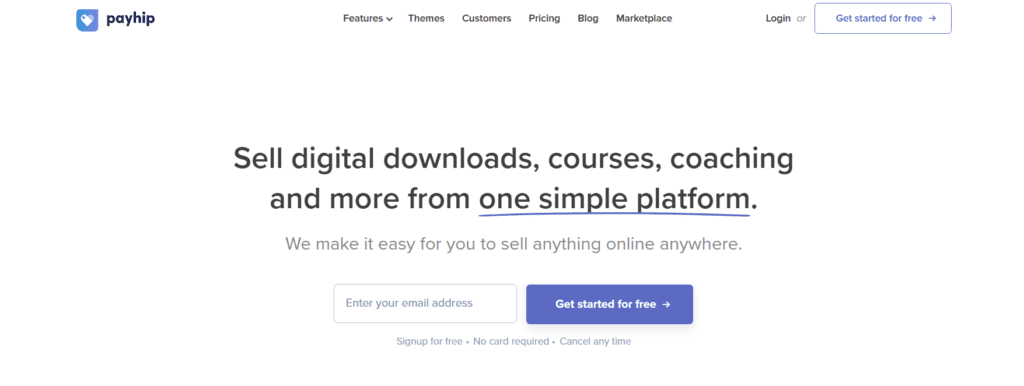
If you haven’t validated your course idea yet and want to start earning without paying monthly fees, Payhip is worth knowing about.
The free plan includes unlimited courses with a 5% transaction fee on sales. No monthly charge, no setup complexity, no reason not to try. As your revenue grows, upgrading to a paid plan removes the transaction fee entirely.
It’s not as polished as Teachable or as powerful as Kajabi, but for a first course, it’s the lowest-risk starting point available.
Platform Comparison: Who Pays the Most?
| Platform | Revenue Share | Monthly Fee | Best For |
|---|---|---|---|
| Udemy | ~37% (platform sales) | Free | Volume traffic, beginners |
| Skillshare | Minutes-watched model | None | Creative, broad-appeal content |
| Teachable | 92.5% (Starter) / 100% (Pro) | From $29/mo | Established creators |
| Thinkific | 100% (all paid plans) | From $99/mo | Multi-course businesses |
| Kajabi | 100% | From $69/mo | All-in-one business |
| Payhip | 95% (free) / 100% (paid) | Free or paid | Beginners, validation |
The Smartest Strategy in 2026
The creators earning the most aren’t picking one platform and staying there forever. They’re using a tiered approach.
Start on Udemy or Payhip to validate that people want your course and to collect testimonials. Once you have proof it sells, move to Teachable or Thinkific where you control the pricing, own the student relationship, and keep far more of every sale.
Platform risk is real. Udemy changes its algorithm and payout terms regularly. Skillshare has adjusted its royalty pool multiple times. Building your own course business on a platform you control – with your own email list – protects you from those changes.
Frequently Asked Questions
Which platform pays course creators the highest percentage? Kajabi, Thinkific, and Payhip (on paid plans) all offer 0% transaction fees, meaning you keep 100% of your sale price minus payment processor fees (typically 2-3%). These outperform Udemy significantly on a per-sale basis.
Is Udemy worth it for new course creators? Yes, as a starting point. Udemy’s built-in audience is valuable when you have no existing following. The trade-off is low per-sale revenue. Most successful creators use Udemy to validate their course and build reviews, then migrate to their own platform.
Can you sell the same course on multiple platforms? Most platforms allow non-exclusive publishing. You can list on Udemy for traffic while also selling on Teachable at full price. Just check each platform’s terms before doing this.
What is the best platform for a first-time course creator with no audience? Udemy for traffic, or Payhip for the lowest-cost independent launch. Both let you start without a large upfront investment.